Why We Grow Hardneck Garlic (And Why You Should Care)
Walk into any Australian supermarket and the garlic you'll find is almost certainly softneck — usually a bland white variety imported from overseas. It's fine for garlic bread. But if you've ever tasted a proper hardneck garlic, you know it's a different experience entirely.
At Indigo Garlic, nearly everything we grow is hardneck. Here's why.
The Difference at a Glance
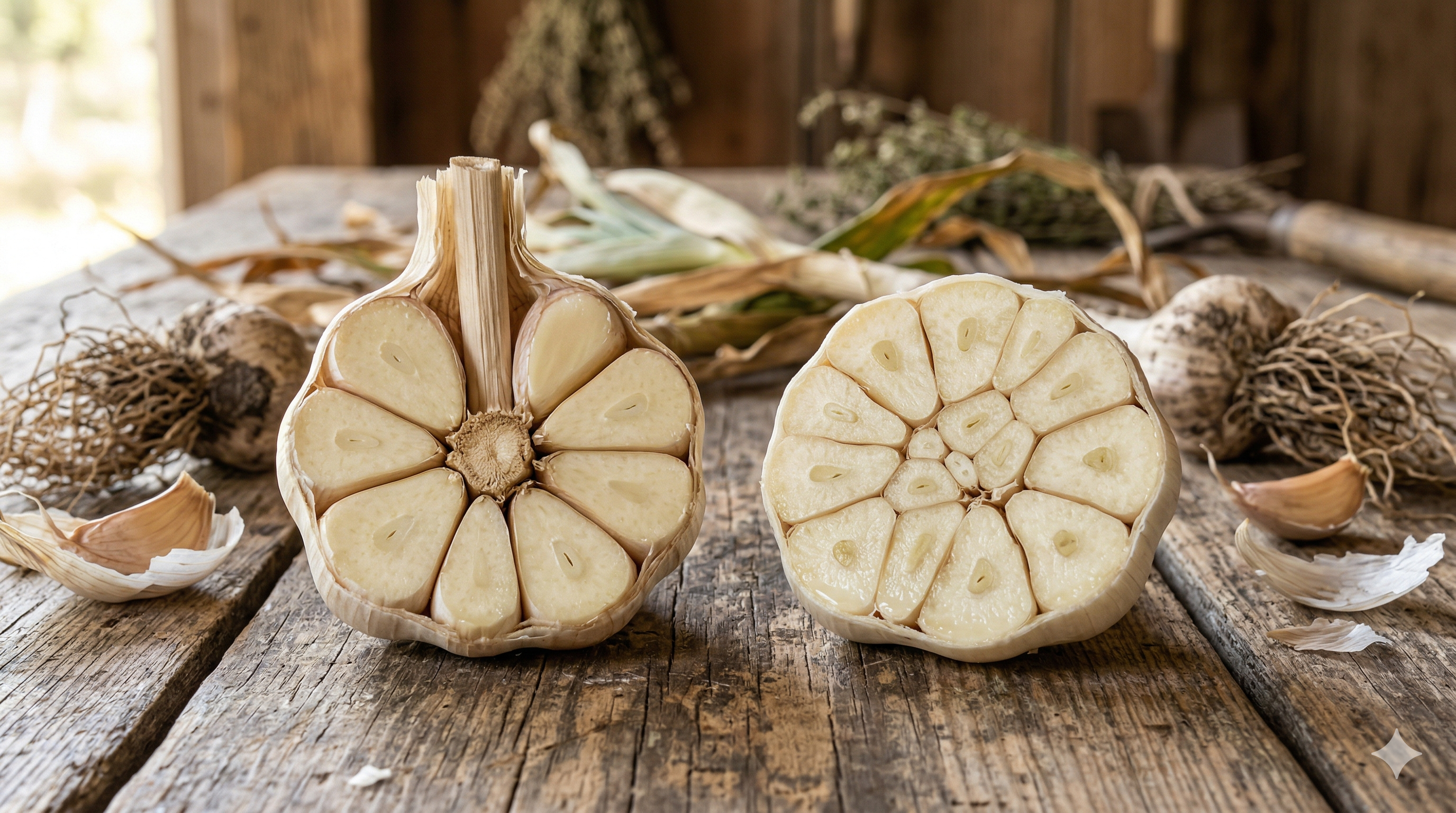
Softneck garlic is what most people picture when they think of garlic — the kind with lots of small cloves in overlapping layers and a pliable neck that's easy to braid. It's the workhorse of commercial garlic farming because it stores well, grows in mild climates, and produces reliable yields.
Hardneck garlic sends up a stiff central stalk called a scape. It produces fewer but much larger cloves — typically 4 to 8 per bulb — arranged in a single ring around the central stalk. It needs genuine cold winters to develop properly, which is why it thrives up here at 1,200 metres in Stanley.
The Flavour Case
This is the simple reason we grow hardneck: it tastes better. Not subtly, not marginally — dramatically.
Hardneck varieties have more complex flavour profiles with notes that range from sweet and nutty (Italian White) to hot and musky (Music) to bold and deeply savoury (Australian Purple). Each variety has character. Softneck garlic, by comparison, tends to taste like... garlic. One note.
Chefs love hardneck because you can choose a variety to match a dish. A gentle Italian White in a delicate pasta. A fiery Australian Purple in a salsa cruda. A smoky Music in a hearty braise.
Why They Need Cold Winters
Hardneck garlic requires vernalisation — a sustained period of cold temperatures — to form proper bulbs. Without at least 6-8 weeks below 10 degrees, the cloves won't differentiate and you'll harvest rounds (single, undivided bulbs) instead of proper heads.
Stanley sits at 1,200 metres in Victoria's alpine northeast. Our winters are genuinely cold — frosts from April through October, snow on the surrounding ridges, and soil temperatures that drop well below what the garlic needs. This isn't a challenge for us. It's our competitive advantage.
The Scape Bonus
In spring, hardneck garlic sends up a curly flower stalk called a scape. We snap these off in November to redirect the plant's energy into bulb growth. But the scapes themselves are a delicacy — a mild, garlicky green that's brilliant in pesto, stir-fries, or pickled in vinegar.
If you order from us in late spring, you might find a bunch of scapes tucked into your box as a bonus. They're one of the best-kept secrets in seasonal eating.
The Honest Trade-Off
Hardneck garlic is harder to grow commercially. It stores for 4-7 months compared to softneck's 9-12. It produces fewer cloves per bulb. It can't be braided for display. And it needs a climate that rules out most of Australia's garlic-growing regions.
We accept all of this because the flavour is worth it. We'd rather grow 2,000 bulbs of extraordinary garlic than 20,000 bulbs of ordinary garlic. And based on what our customers tell us, they agree.
Our Varieties
- Australian Purple — Our signature. Bold and pungent with staying power. The one that converts people.
- Music — A porcelain hardneck with enormous cloves and a hot, musky depth. The chef's choice.
- Italian White — Technically a softneck, but one with real personality. Milder and sweeter, perfect for everyday cooking.
Each variety is selected for flavour first, and we're always trialling new ones. Growing garlic is a long game — you plant in autumn and don't know the result until the following summer. But that patience is part of what makes it rewarding.